Gambling in the United Kingdom is one of the most structured and regulated markets in the world. It operates under a licensing system rather than a state monopoly, which allows private companies to legally provide gambling services. This system ensures fairness, transparency, and consumer protection.
The industry has grown significantly over the years, especially with the rise of online platforms. Today, gambling contributes billions to the UK economy and remains a key part of the entertainment sector. According to recent data, the total Gross Gambling Yield (GGY) reached £16.8 billion in 2024–2025, highlighting its economic importance .
Legal Status of Gambling in the UK
Licensing Framework and Authorities
Gambling in the UK is fully legal when conducted under proper licensing. Private operators must obtain licenses to offer services such as casinos, sports betting, and online gaming. The market is not state-run, except for the National Lottery, which operates under a government concession.
This licensing model promotes competition while maintaining strict regulatory oversight. Operators must comply with codes of practice, ensuring fair play and responsible gambling measures.
Age Restrictions and Player Eligibility
Strict age restrictions apply across all gambling activities. Most forms of gambling require participants to be at least 18 years old. However, the National Lottery currently allows participation from age 16, though this will change to 18 by 2026 .
Regulatory Bodies and Their Roles
UK Gambling Commission Overview
The UK Gambling Commission is the primary regulatory authority. Established under the Gambling Act 2005, it oversees licensing, enforcement, and compliance. It ensures operators follow rules related to fairness, transparency, and player protection .
Role of Local Authorities
Local authorities also play a role in licensing physical gambling venues such as betting shops and casinos. They ensure compliance with local laws and community standards.
UK Gambling Market Snapshot
The UK gambling market remains large, licensed, and increasingly digital. Recent research shows total gross gambling yield reached £16.8 billion, with online gambling leading growth.
UK Gambling Tax Breakdown
In the UK, operators pay tax on gross gambling profits, while players generally do not pay tax on winnings. Different products are taxed at different duty rates.
How Gambling in Great Britain Is Regulated
The British market is licensed rather than state-run. Most gambling activity is legal only when offered by approved operators under the oversight of the UK Gambling Commission.
1. Licensed Market Model
2. UK Gambling Commission Oversight
The UK Gambling Commission regulates betting, casinos, bingo, arcades, machines, and remote operators across Great Britain.
3. Age Controls and Safer Gambling
Most gambling products require players to be 18+. Operators must also support safeguards such as self-exclusion tools and affordability checks.
4. Advertising and Bonus Restrictions
Gambling ads must not target minors or vulnerable people. New rules from January 2026 also tighten bonus structures and cap wagering requirements at 10×.
5. Consumer Protection Measures
Credit cards for gambling were banned in 2020, and all licensed online operators must participate in the national self-exclusion scheme, Gamstop.
Market Size and Economic Impact
Total Gross Gambling Yield (GGY)
The UK gambling market is massive. In 2024–2025, the total GGY reached £16.8 billion, with £12.6 billion excluding lotteries . This figure represents the total amount retained by operators after payouts.
Online vs Land-Based Gambling
Online gambling has become the dominant force in the industry. Remote gambling generated £7.8 billion, compared to £4.8 billion from land-based venues .
Growth Trends Post-Pandemic
The industry has rebounded strongly after COVID-19. Online gambling grew by 13.1%, while land-based gambling increased by 3.6% . This shows a clear shift toward digital platforms.
Sector Breakdown of Gambling Industry
Online Casino Dominance
Online casinos are the largest segment, generating £5.0 billion in revenue. Slot machines alone contributed £4.2 billion, making them the most profitable category .
Sports Betting and Bingo
Remote betting contributed £2.6 billion, while online bingo added a smaller share of £0.17 billion .
National Lottery Contributions
The National Lottery generated £7.9 billion in ticket sales, with a significant portion allocated to public causes .
Taxation System in UK Gambling
Key Gambling Taxes Explained
The UK applies several taxes on gambling operators, all based on gross profits rather than player winnings. Players do not pay tax on their winnings.
Key taxes include:
- General Betting Duty (GBD): 15% of betting profits
- Remote Gaming Duty (RGD): 21% for online gaming
- Bingo Duty: 10% (to be abolished in 2026)
- Lottery Duty: 12% of ticket prices
- Machine Games Duty (MGD): Up to 25% depending on machine type
Remote Gaming Duty and Betting Duty
Remote Gaming Duty is particularly important due to the growth of online gambling. It directly impacts online casinos and digital platforms.
Machine Games Duty and Lottery Duty
Machine Games Duty varies based on stake levels, while Lottery Duty remains fixed.
Future Tax Changes and Policies
Upcoming 2026–2027 Reforms
The UK gambling sector is preparing for major tax reforms that will significantly reshape the industry. These changes aim to modernize taxation and ensure that the rapid growth of online gambling is fairly regulated.
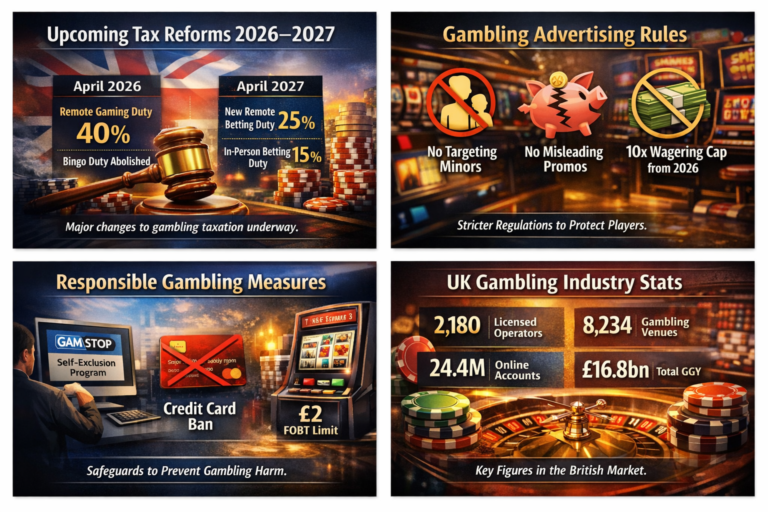
From April 2026, the Remote Gaming Duty (RGD) is expected to increase sharply from 21% to 40%, reflecting the government’s focus on capturing more revenue from digital platforms. At the same time, Bingo Duty will be abolished, simplifying the tax structure for that segment .
Looking ahead to April 2027, a new Remote Betting Duty of 25% is planned. This will align online betting taxes more closely with other digital gambling products. Meanwhile, traditional in-person betting will continue to be taxed at 15%, maintaining a distinction between retail and online operations .
These reforms highlight a clear trend: governments are increasingly targeting online gambling revenues, as this segment continues to dominate market growth.
Advertising and Promotion Rules
Restrictions on Gambling Ads
Advertising in the UK gambling industry is tightly controlled. All operators must follow strict rules designed to protect vulnerable individuals, especially minors.
Key advertising restrictions include:
- Ads must not target children or young people
- Promotions cannot suggest gambling as a solution to financial or personal problems
- Marketing must not portray gambling as socially desirable or risk-free
Regulatory bodies such as the Advertising Standards Authority (ASA) enforce these rules alongside the Gambling Commission .
Bonus and Promotion Regulations
New rules coming into effect in January 2026 will further tighten control over promotions. These include:
- A ban on mixed-product promotions (e.g., requiring betting across multiple game types)
- A cap on wagering requirements at 10×
These changes are designed to make offers clearer and reduce the risk of misleading players.
Player Protection and Responsible Gambling
Self-Exclusion Programs
The UK is a global leader in responsible gambling measures. One key initiative is Gamstop, a national self-exclusion scheme that allows players to block themselves from all licensed online gambling platforms.
All licensed operators are required to participate in this system, ensuring comprehensive coverage.
Credit Card Ban and Betting Limits
To reduce gambling-related harm, the UK introduced a credit card ban in 2020, preventing players from using borrowed money to gamble .
Additionally, strict limits have been placed on betting machines. For example:
- Fixed-odds betting terminals (FOBTs) now have a maximum stake of £2 per spin
Operators must also conduct affordability checks and monitor player behavior to identify potential risks.
ndustry Data and Player Statistics
Number of Operators and Venues
The UK gambling industry includes a wide network of businesses and venues. As of March 2025:
- Around 2,180 licensed gambling businesses operate in Great Britain
- Approximately 8,234 gambling venues are active, including betting shops, casinos, and arcades
Interestingly, the number of physical betting shops has been declining as more players shift online.
Active Users and Accounts
Online gambling continues to grow rapidly:
- Around 24.4 million active online accounts were recorded in early 2025
- Approximately 24 million adults gamble annually in the UK
- Around 10.5 million people gamble online regularly
This data shows just how widespread gambling participation is across the country.
FAQs About Gambling in the United Kingdom
Yes, gambling is legal when conducted under a licensed framework regulated by the UK Gambling Commission.
No, players do not pay tax on winnings. Taxes are applied to operators’ profits instead.
It is the main regulatory body responsible for licensing and overseeing gambling activities in Great Britain.
The market generated £16.8 billion in Gross Gambling Yield in 2024–2025 .
Online gambling accounts for roughly 46% of total GGY and continues to grow.
Major taxes include General Betting Duty (15%), Remote Gaming Duty (21%), and Lottery Duty (12%)
Gambling in the United Kingdom stands out as one of the most mature and well-regulated markets globally. Its licensing-based model ensures a balance between economic growth and consumer protection.
With a market value exceeding £16 billion and a strong shift toward online platforms, the industry continues to evolve rapidly. Future tax reforms, stricter advertising rules, and advancing technology will shape its trajectory in the coming years.
For businesses and players alike, understanding the structure of gambling in the United Kingdom is essential. It offers both opportunities and responsibilities in an increasingly digital and regulated environment.