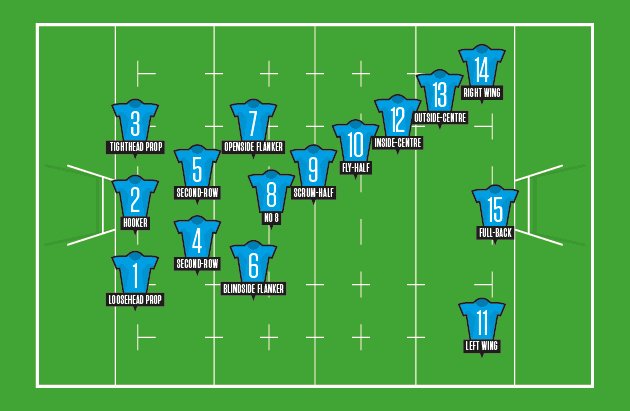
Rugby positions are the backbone of how the game works. Whether you’re watching a match or stepping onto the field for the first time, understanding rugby positions helps you see how strategy, teamwork, and skill all come together.
Each player has a specific role, and those roles are grouped into two main categories: forwards and backs. Together, they form a 15-player team in rugby union, each wearing a number that reflects their position and responsibilities.
Rugby Team Structure
The 15-Player Formation
A standard rugby union team has:
- 8 Forwards – strong, physical players who win possession
- 7 Backs – fast, agile players who create scoring opportunities
This structure is the foundation of all rugby formation strategies.
Rugby Positions and Numbers
Rugby uses a fixed numbering system that directly matches each position.
| Number | Position | Role |
|---|---|---|
| 1 & 3 | Prop | Power in scrums |
| 2 | Hooker | Wins the ball |
| 4 & 5 | Locks | Lineout jumpers |
| 6 & 7 | Flankers | Tackling and turnovers |
| 8 | Number 8 | Controls ball at scrum |
Backs Numbers (9–15)
| Number | Position | Role |
|---|---|---|
| 9 | Scrum Half | Passes from scrum |
| 10 | Fly Half | Playmaker |
| 11 & 14 | Wings | Speed and scoring |
| 12 & 13 | Centers | Attack and defense |
| 15 | Fullback | Last line of defense |
Rugby Positions & Tactics
Select a Position
Click any jersey number on the field to explore the technical, physical, and tactical demands of that rugby position.
Loose-head Prop
Front Row / Tight Five
Role Description
Tactical Geometries & Formations
Advanced TheoryChannel Systems
The pitch is often split into four attacking lanes. Teams use Channel 1 for close-range forward carries, while the outer channels are better for pace, width, and finishing moves.
Alignment Depth
Flat alignment attacks space quickly before the defense sets. Deeper alignment creates more time to pass, read pressure, and build speed onto the ball.
Defensive Architecture
A blitz defense rushes hard to shut down time and space. A drift defense moves laterally, guiding the attack toward the touchline and reducing options out wide.
Rugby Forward Positions
Forwards are the engine room of the team. They focus on strength, physical contests, and gaining possession.
Front Row Rugby
The front row includes:
- 2 Props (1 & 3)
- 1 Hooker (2)
Rugby Prop
The rugby prop plays a crucial role in the scrum. Props are:
- Strong and heavy
- Responsible for stability
- Key in pushing against opponents
The term prop in rugby refers to anchoring the scrum and protecting teammates.
Rugby Hooker
The rugby hooker stands between the props and has two main jobs:
- Hook the ball in scrums
- Throw the ball in lineouts
Hookers must be both strong and precise.
Second Row (Locks)
Players wearing numbers 4 and 5 are called locks.
Their roles include:
- Jumping in lineouts
- Providing pushing power in scrums
- Supporting open play
They are usually the tallest players on the team.
Back Row (Flankers and Number 8)
Flankers (6 & 7)
- Fast and aggressive
- Excellent tacklers
- Compete for possession
Rugby Number 8
The rugby number 8 is unique:
- Controls the ball at the back of the scrum
- Links forwards and backs
- Often carries the ball forward
Rugby Scrum Positions
Scrums are one of the most iconic parts of rugby.
Scrum Formation
The rugby scrum positions are arranged in three rows:
- Front Row: Props + Hooker
- Second Row: Locks
- Back Row: Flankers + Number 8
Each player must bind together and push as a unit to win the ball.
Rugby Backline Positions
Backs are responsible for speed, creativity, and scoring.
Scrum Half Number (9)
The scrum half number is the link between forwards and backs.
Responsibilities:
- Pass the ball quickly
- Control tempo
- Make quick decisions
Fly Half (Number 10)
What Position is Number 10 in Rugby?
The number 10 is the fly half, often the most important decision-maker on the field.
Key duties:
- Direct attacking plays
- Kick strategically
- Control the game
Centers (12 & 13)
Centers combine strength and speed.
They:
- Break defensive lines
- Create space
- Defend against attacks
Wings (11 & 14) and Fullback (15)
- Wings: Fastest players, finish tries
- Fullback: دفاع and counter-attacks
Rugby Positions and Roles
Each position has a clear responsibility:
- Forwards: Win and retain possession
- Backs: Use possession to score
Understanding rugby positions and roles helps you see the game like a pro.
Rugby Positions Body Types
Different positions suit different physiques:
| Position Type | Ideal Body Type |
|---|---|
| Props | Heavy, strong |
| Locks | Tall, athletic |
| Flankers | Lean, powerful |
| Scrum Half | Small, agile |
| Fly Half | Balanced |
| Wings | Fast, lightweight |
Rugby Formation Explained
A rugby formation is not just about positions—it’s about strategy.
Teams adjust formations based on:
- Opponent tactics
- Field position
- Game situation
Rugby Positions Explained for Beginners
If you're new to rugby:
- Think of forwards as the power
- Think of backs as the speed
- Each number = a specific role
That’s the simplest way to understand rugby positions explained.
❓ FAQs About Rugby Positions
There are 15 positions in rugby union.
The fly half (number 10) is often considered the most influential.
A prop rugby player provides strength in scrums and supports physical play.
The hooker rugby role involves winning the ball in scrums and throwing lineouts.
The rugby number 8 controls the ball at the back of the scrum and links play.
They are the forward positions involved in the scrum formation.
Rugby is a game of structure, strength, and strategy—and understanding rugby positions unlocks a deeper appreciation of the sport. From the powerful props in the front row to the quick-thinking fly half and lightning-fast wings, every role matters.
Whether you're a beginner or a fan looking to sharpen your knowledge, knowing rugby positions and numbers gives you a whole new way to enjoy the game.